
Why "Just Lump It All Together" Is Costing You
The case for breaking out your fixed assets - one by one
Let's talk about something that sounds a little dry on the surface but can quietly cause you real headaches down the road: how you track your fixed assets.
We know, we know - "fixed assets" isn't exactly the phrase that makes anyone lean in. But stick with us, because this is one of those behind-the-scenes bookkeeping choices that makes a genuine difference in how clearly you can see your business. And clarity, as always, is the whole point.
First, what even is a fixed asset?
Nothing scary here. A fixed asset is just a bigger, long-term thing your business owns and uses to make money - something you'll keep and use for years rather than sell right away. Think vehicles, machinery, computers, equipment, or a building.
If it's a substantial purchase that sticks around and helps you run the business, there's a good chance it belongs in your fixed assets.
The mistake we see all the time
Here's where a lot of business owners take a well-meaning shortcut: they dump every asset of a similar type into one big bucket. All the company trucks and vans get recorded under a single "Vehicles" account, and that's that.
It feels simpler, and we get the appeal. But that shortcut tends to come back around and bite you, in a few ways:
You lose visibility. When everything's mashed together, it's really hard to see what any individual asset is worth, how it's depreciating, or what it's costing you to maintain.
Your reports get fuzzy. Lumped-together assets can hide the true picture - a gain here, a loss there - so your financials don't tell you the full story.
Compliance gets risky. Auditors and tax authorities often want to see detailed, itemized asset records. A single blurry "Vehicles" line may not cut it.
Why breaking them out is worth the small effort
When you list each asset on its own, a lot of good things fall into place:
You actually manage your stuff. You can see the condition, location, and use of every item - which makes it easier to schedule maintenance, plan replacements, and notice if something goes missing.
Depreciation gets accurate. Every asset has its own purchase date, cost, and useful life. Breaking them out lets you track depreciation precisely, so your books reflect what things are really worth today.
Your financials get trustworthy. Clean, detailed records give you - and any lender or investor - a clear, honest picture of what you've invested in and how healthy the business is.
Audits get so much easier. When each asset is already itemized, tax time and audits go from "frantic reconstruction" to "here you go, it's all right here."
You make smarter calls. When you know exactly what each asset is worth and how it's performing, decisions about buying, selling, or upgrading get a whole lot clearer.
What this looks like in real life
Say you've got a few vehicles. Instead of one lonely "Vehicles" account, you'd give each one its own line with the details that matter:
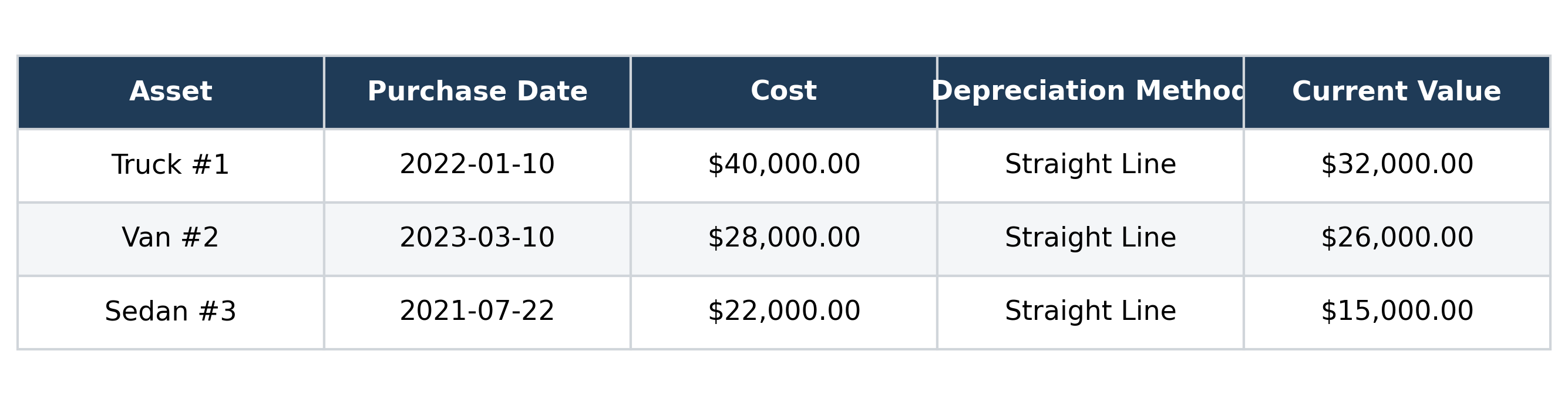
See how much more you can see? At a glance you know what each vehicle cost, how it's depreciating, and what it's worth right now. That's the kind of clarity that makes running your business feel less like guessing.
A few simple habits that keep it painless
You don't need a fancy system - just a little consistency:
Give each asset its own unique name or ID.
Record the details that matter: purchase date, cost, location, serial number, and depreciation method.
Keep it current - update your records when you buy, sell, or retire something.
Lean on your accounting software's fixed-asset tools to automate the tracking (this is exactly the kind of busywork software is great at).
The bottom line
Breaking out your fixed assets isn't just a "nice to have" - it's one of those small, unglamorous habits that quietly protects you. It keeps your reports honest, your audits calm, and your decisions grounded in real numbers instead of guesses.
And if all of this makes you want to close the laptop and go do literally anything else? That's exactly what we're here for. At KPA Services, sorting out the details so you can see your business clearly - and feel confident about it - is the whole point. Reach out anytime, and we'll make sure your assets are tracked the right way from here on out.


